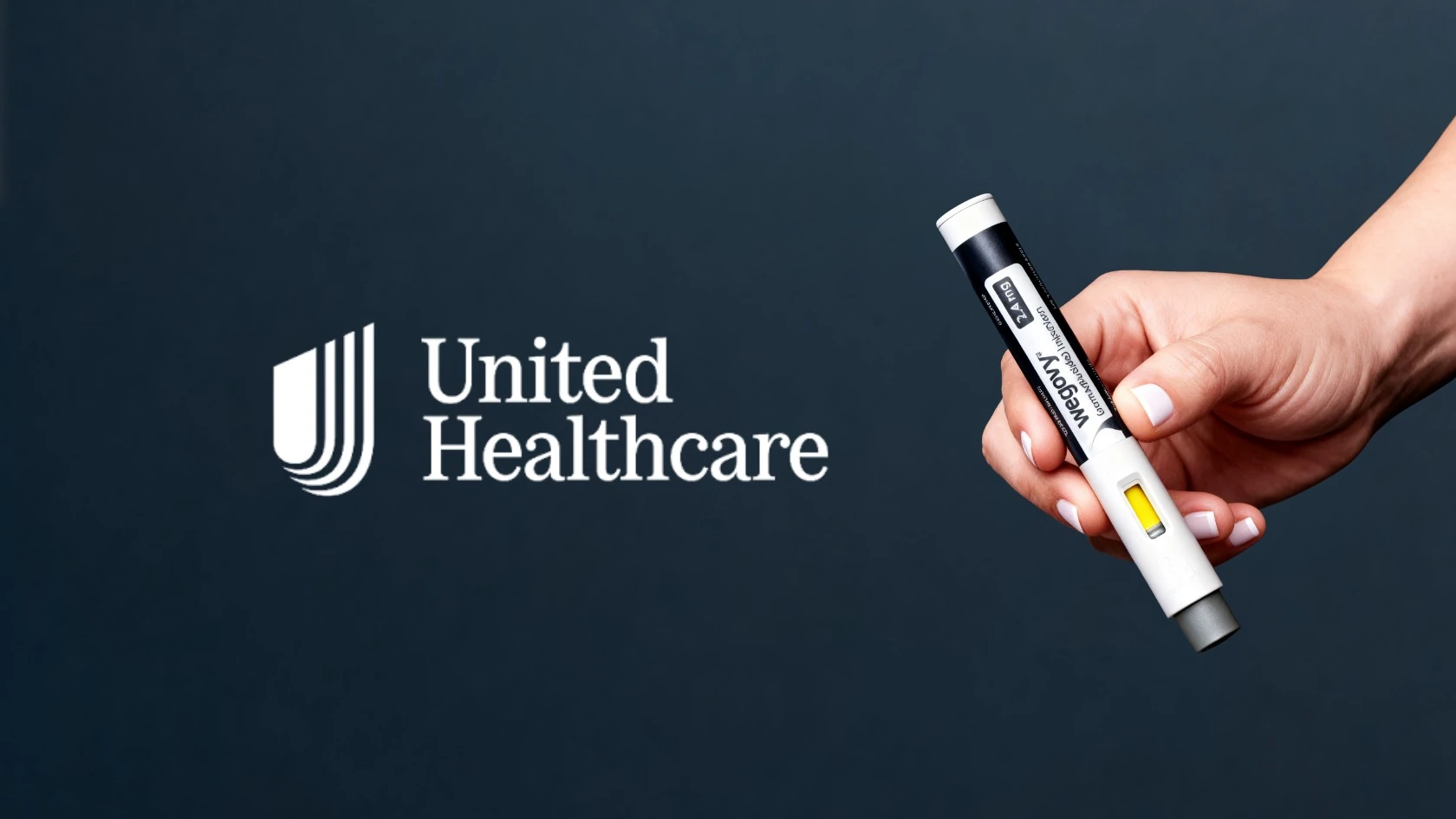
- UnitedHealthcare coverage for Wegovy and Zepbound varies significantly by plan type — employer-sponsored, marketplace, Medicare Advantage, and Medicaid managed care plans each have different formularies and exclusions
- Some UHC plans cover one medication but not the other, so verifying your specific formulary is essential
- Prior authorization is required for nearly all UHC plans that cover either medication, including BMI documentation and comorbidity evidence
- Both drugs have additional FDA-approved indications — Wegovy for cardiovascular risk reduction and Zepbound for obstructive sleep apnea — that may create alternative coverage pathways
- PEAK’s insurance team handles benefits verification and prior authorization with UHC before your first visit
Note: PEAK accepts UnitedHealthcare commercial plans. We do not accept UHC Medicare Advantage or UHC Community Plan (Medicaid) products.
UHC coverage overview
UnitedHealthcare is one of the largest health insurance providers in Virginia, covering millions of members across employer-sponsored, individual, Medicare, and Medicaid plans. If you carry a UHC card, the question of whether Wegovy or Zepbound is covered is one we hear frequently — and the answer is never simple.
Wegovy (semaglutide 2.4 mg) and Zepbound (tirzepatide) are both FDA-approved for chronic weight management in adults with a BMI of 30 or higher, or 27 or higher with at least one weight-related comorbidity. Despite these indications, UHC does not have a single, uniform policy on either medication. Coverage depends entirely on your specific plan design — and some plans cover one but not the other.
UnitedHealthcare administers hundreds of different plan configurations. Each employer, government program, or marketplace product defines its own formulary, exclusions, and prior authorization criteria. Two people with UHC cards can have completely different coverage for the same medication. Wegovy and Zepbound may also have different formulary placements within the same plan.
Plan types and coverage
Your UHC plan type is the single biggest factor in determining whether Wegovy or Zepbound is covered. Here is how the major plan categories typically handle anti-obesity medications:
Employer-sponsored plans
Employer-sponsored plans are the most common source of Wegovy and Zepbound coverage through UHC. However, coverage is not guaranteed. The employer — not UnitedHealthcare — decides which anti-obesity medications are included in the plan’s formulary. Some plans cover Wegovy but not Zepbound, or vice versa. Large employers are more likely to include one or both, but many mid-size and small employers exclude weight loss medications entirely to manage costs.
If your employer uses a self-funded plan administered by UHC, the formulary decisions are made by your employer’s benefits team, not by UnitedHealthcare. This is an important distinction because it means UHC’s published formulary may not apply to your plan.
ACA marketplace plans
UHC offers marketplace plans in several states, including Virginia. Coverage for Wegovy and Zepbound on marketplace plans varies by plan tier and state. Anti-obesity medications are not classified as essential health benefits under the ACA, so marketplace plans are not required to cover them. Some UHC marketplace plans include one or both medications on their formulary; many do not.
Medicare Advantage
UHC is the largest Medicare Advantage carrier in the country. Historically, Medicare has not covered anti-obesity medications for weight loss. However, this is changing. Some UHC Medicare Advantage plans have begun offering limited coverage, particularly under additional FDA-approved indications such as Wegovy’s cardiovascular indication (PEAK does not accept Medicare Advantage plans). Coverage under traditional Medicare Part D remains restricted for weight management.
Medicaid managed care
UHC administers Medicaid managed care plans in several states. Medicaid coverage for GLP-1 medications is determined at the state level and varies widely. In Virginia, Medicaid coverage for GLP-1 medications for weight management is limited. If you are on a UHC Medicaid plan, benefits verification is essential before starting treatment.
UHC individual plans, short-term plans, and plans with explicit anti-obesity medication exclusions typically do not cover Wegovy or Zepbound. If your plan documents include a weight loss medication exclusion, both medications will generally be denied regardless of medical necessity — unless an additional FDA-approved indication applies.
Prior authorization requirements
For UHC plans that cover Wegovy or Zepbound, prior authorization is almost always required for both medications. This is a process where your prescribing clinician submits clinical documentation to UHC proving that the medication is medically necessary for you.
UHC’s typical prior authorization requirements for Wegovy and Zepbound include:
- BMI documentation — A documented BMI of 30 or higher, or BMI of 27 or higher with at least one weight-related comorbidity such as type 2 diabetes, hypertension, dyslipidemia, or obstructive sleep apnea
- Comorbidity evidence — Clinical records documenting the specific comorbidities that support the medical necessity of treatment
- Supervised weight management history — Evidence of participation in a structured weight management program, which may include diet, exercise, and behavioral counseling, typically for 3 to 6 months prior to the request
- Prescriber qualifications — The prescriber must be a physician, nurse practitioner, or physician assistant with appropriate prescribing authority
UHC reviews prior authorizations against specific clinical policy bulletins. Matching your documentation to the exact criteria in their policy — not just general medical necessity — is what drives approvals.
The PA criteria for Wegovy and Zepbound are similar but not always identical — UHC may have different step therapy requirements or formulary placement for each. At PEAK, our clinical team documents everything from your first visit with UHC’s PA requirements in mind. We know what UnitedHealthcare reviewers look for because we submit these requests routinely.
Formulary placement
Where Wegovy and Zepbound sit on your UHC formulary directly affects what you pay out of pocket. UHC formularies organize medications into tiers, and the tier placement determines your copay or coinsurance amount. Wegovy and Zepbound may be on different tiers within the same plan.
| Formulary tier | Typical cost impact |
|---|---|
| Preferred brand (Tier 2) | Lower copay, typically $25 – $75/month |
| Non-preferred brand (Tier 3) | Higher copay, typically $150 – $300+/month |
| Specialty tier (Tier 4–5) | Coinsurance (20–33%), may require specialty pharmacy |
| Not on formulary | Not covered — full cash price ($1,300+/month) |
Both Wegovy and Zepbound are most commonly placed on the non-preferred brand or specialty tier when covered. This means your out-of-pocket cost may be higher than a standard copay. Your deductible status, coinsurance percentage, and out-of-pocket maximum all affect the final cost.
If your UHC plan places Wegovy or Zepbound on a non-preferred or specialty tier, manufacturer savings programs can significantly reduce what you pay at the pharmacy. The Wegovy Savings Card (Novo Nordisk) and Zepbound Savings Program (Eli Lilly) each have their own eligibility requirements and copay limits. We check which program applies to your specific UHC tier placement and help you enroll before your first fill.
Additional coverage pathways
Because UHC evaluates each medication under its own clinical policy bulletin, additional FDA-approved indications can open separate coverage pathways — sometimes through medical benefit rather than pharmacy benefit.
Wegovy — cardiovascular risk reduction
In March 2024, the FDA approved Wegovy for reducing the risk of major adverse cardiovascular events (heart attack, stroke, and cardiovascular death) in adults with established cardiovascular disease and overweight or obesity. This approval was based on the SELECT trial, which demonstrated a 20% reduction in cardiovascular events. If you have documented cardiovascular disease, your clinician may be able to submit the prior authorization under the cardiovascular indication rather than the weight management indication.
Zepbound — obstructive sleep apnea
In December 2024, the FDA approved Zepbound for the treatment of moderate-to-severe obstructive sleep apnea (OSA) in adults with obesity. This was based on the SURMOUNT-OSA trial data. If you have a documented OSA diagnosis alongside obesity, this indication may provide a separate pathway for UHC coverage of Zepbound — potentially under medical benefit criteria rather than a pharmacy formulary.
Because UHC administers so many different plan configurations, a medication that is excluded under one clinical policy bulletin may be covered under a different one. Self-funded employer plans in particular may have separate coverage criteria for cardiovascular and sleep apnea medications than they do for weight management drugs. Your clinician must document the relevant diagnosis and clinical history. At PEAK, we identify which policy pathway gives your plan the strongest basis for approval.
If you’re denied
A denial from UnitedHealthcare is not the end of the process. UHC has a structured appeals process with specific timelines and procedures. Understanding these timelines is critical to protecting your rights.
If your prior authorization for Wegovy or Zepbound is denied, here are the steps available:
- Peer-to-peer review — Your prescribing clinician can request a phone call with a UHC medical director to discuss your case. This is often the fastest way to overturn a denial when the clinical documentation is strong. UHC typically schedules peer-to-peer reviews within 5 to 7 business days of the request.
- First-level appeal — You or your clinician can submit a formal appeal within 180 days of the denial. UHC is required to respond to standard appeals within 30 calendar days. For urgent situations, expedited appeals must be decided within 72 hours.
- External review — If UHC upholds the denial on appeal, you may have the right to request an independent external review. An external reviewer not affiliated with UHC evaluates your case against clinical evidence and coverage criteria.
- Alternative clinical pathway — If the weight management indication is denied, your clinician may explore additional indications (cardiovascular for Wegovy, sleep apnea for Zepbound) or recommend alternative FDA-approved medications that are on your UHC formulary.
Standard appeal: 30 calendar days for a decision. Expedited appeal: 72 hours. External review: varies by state, typically 45 days. Keep copies of all denial letters and appeal submissions — your clinician’s office should manage this documentation, but having your own records is important.
How PEAK helps with UHC
UHC’s plan variability means that coverage questions rarely have a simple answer. Our insurance team works directly with UnitedHealthcare to get the specifics of your plan — not just what the published formulary says.
Here is how we approach UHC cases:
- Benefits verification. We check your UHC plan for Wegovy and Zepbound coverage, formulary tier, and any exclusions — before your first appointment. We contact UHC directly and verify the specifics of your plan, not just what the published formulary says.
- Prior authorization. Our clinical team prepares and submits your PA with the documentation UHC requires. We structure the clinical narrative around UHC’s specific criteria because we work with their review process regularly.
- Denial management. If your PA is denied, we manage the appeal process, including peer-to-peer reviews with UHC medical directors and formal written appeals.
- Alternative pathways. If one medication is not covered under your UHC plan, we evaluate whether the other medication is on your formulary, assess additional FDA-approved indications that may apply to your clinical profile, and explore manufacturer savings programs.
UHC plans are complicated — published formularies do not always match what self-funded employers actually cover. We verify your specific plan details directly with UnitedHealthcare so you know exactly what is covered, what your copay will be, and whether a savings card applies before your first appointment.